|
|
 |

 July 9, 2006 Sunday July 9, 2006 Sunday
Alamid Coffee
Coffee What?
The civet (aka alamid, bearcat or musang) eats ripe coffee cherries, but can't digest the beans, so they pass it out. People scour the forest floor in search of this (undigested coffee beans or alamid shit, for short), clean it, dry it, roast it, and sell it for an arm and a leg. On my climb to Mt. Cristobal, I even chanced on
alamid coffee shit. There wasn't enough of it, so I didn't bother to scoop it up.
Arm and a Leg
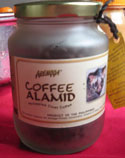
I've talked about alamid coffee on a few occassions, but never had a chance to try it, until now. Why? Well, it's a celebratory gift for getting my website, TheLoneRider.com, #1 in Google's organic search for "mountain biking mountaineering". A
100-gram jar of alamid coffee was being sold for P700 at a coffee bean stall at Baguio Market. At this price level, it's more expensive than Jamaican Blue Mountain, the Rolls Royce of coffee. Even with that price level (or perhaps because of it), supply has never caught up with global demand.
Coffee Quadrant
Coffee is really a complex beverage that balances four things: acidity, aroma, texture and taste. Kenya AA boosts of its acidity (yes, in coffee, acidity is a good thing). Jamaican Blue Mountain is velvety smooth (ha-ha, assuming the coffee purveyor in New York gave me the real thing). Indonesian Java has a gamey taste and Colombian Supremo has great aroma. Some coffee don't excel in any of those but serve as an excellent base for blending, like Brazillian Santos. It's very rare for any one single coffee to possess all those attributes. That's why master blenders blend various coffees to arrive at that optimum balance.
Verdict
Assuming I was sold the genuine article (ha-ha, the next door competition hinted it wasn't), here's the lowdown, after brewing alamid coffee side-by-side with Kalinga Arabica using the
plunger pot method. The texture is exceptionally smooth. The acidity is almost non-existent. There is no aroma and the taste is ok...yes, just good. If I paid the regular price for this coffee, around P120/kilo, I would say it's very good coffee for the price. But at P7000/kilo, it's a friggin rip-off. If you wanna spend this kind of dough on alamid coffee, there's a bridge in Brooklyn that's going for a steal.
--- TheLoneRider
- if you're buying a coffee grinder, choose the burr-type instead of the blade type. The burr-type grinds coffee to a more consistent grade (a little pricey but worth it)
- coffee goes stale fast. Store it in the freezer.
- don't use boiling water to brew coffee. Wait a minute for the boiled water to cool a bit before pouring into the coffee grounds. Boiling water releases the bitter alkaloides in coffee.
- have your coffee beans ground according to your brewing device. French Press, coarse. Drip coffee maker, fine. Espresso, very fine. Ibrik (Turkish way of brewing), pulverized
- use cream (the one for making fruit salad) for coffee instead of milk or Coffeemate for superior taste and texture
- ground coffee absorbs external odors - keep it insulated
- Vietnamese Phin Coffee Filter Dec 2, 2021
- 'Must Experience' Cafés of Chiang Mai Nov 30, 2021
- Exploring Nong Khai's Cafe Culture Jun 10, 2020
- Cafescape of Hanoi's Old Quarter, Vietnam Jan 6-24, 2019
- Rediscovering the Cafe Tradition of Ho Chi Minh City Aug 7-27, 2018
- Exploring the Cafe Scene of Tagbilaran Oct 7, 2017
- Discovering the Neighborhood Cafes of Singapore Aug. 8-22, 2016
- Discovering Saigon's Cafe Culture Nov 9 - Dec 17, 2014
- The Perfect Coffee Brew Feb 13, 2008
- Exploring the Emergent Cafe Culture of Penang Jun 18, 2016
- Coffee Review: Himalayan Java Coffee Dec. 18, 2013
- Homemade Bread Breakfast Aug 1, 2006
- Alamid Coffee Jul 9, 2006
- Communal Forest with a Newbie May 4, 2006
- Civet 'Coffee-Shit' on Mount Cristobal Mar 11, 2006
- The Afternoon Coffee Ritual Dec 12, 2002


July 9, 2006
»» next story: Locked Out
»» next Food story: Atayan - Sagada Truffle
»» back to Food Odyssey
»» back to Homepage
|
 |
 |
|